WRITING 101-DAY 4- SERIALLY LOST – PART TWO

As I stared out through the windscreen across the seemingly endless stoney desert I was at a loss to understand why I couldn’t see the bore and its windmill that was supposed to be in sight. I checked the odometer, the compass, the Magellan and the 1:250,000 map. According to my calculations I should be right on the bore or be able to seed it at least.

This is where for outback travellers like myself, the HF radio and the VKS-737 network are  essential travelling companions.  Quickly running through a few HF channels I noticed that there wasn’t much traffic, probably because it was getting towards late afternoon and sometimes getting a channel on the right frequency can be problematic.

Anyway I decided to make a voice call, not a cell call to the Charters Towers  Base Station. After going through the correct voice procedure protocols I gave the operator my location Latitude 28’16” latitude and 132’50” Longitude and asked how far I was from Coober Pedy. The operator had a bit of a laugh and told me I was way off course and should be heading roughly north east towards Latitude 29’01”, Longitude 134’45”.

Suddenly I knew where I’d gone wrong. For years I’ve resisted wearing my reading glasses and when I looked up Coober Pedy in the Gazetteer I’d recorded the coordinates for Coober Peedy in Western Australia and thats where I’d been heading, not for Coober Pedy in South Australia, my wanted destination.

I thanked the operator and felt like a proper fool as I terminated the voice call with the appropriate ‘Out’. At least now I didn’t have to be concerned about locating the bore and its windmill. It was many many miles away. Good I thought, one less thing to worry about.

Under the circumstances, I took the only action appropriate at the time. I boiled the billy and had a cup of nice sweet black tea and a couple of biscuits.

Then after resetting the Magellan with the corrector coordinates I set off slowly in the right direction, pleased that on this occasion I’d asked for directions before I went too much further. Not that I had really needed to. After all, my super accurate sense of direction, always spot on, would  have soon switched in and given me a few helpful hints about an adjustment to my travelling direction. Fortunately I wasn’t on a tight schedule and time was on my side. At this point in the trip anyway.

After another hour or so cross country at a reasonably slow rate to conserve my tyres from the rocky ground I came across the remains of this old vehicle and long abandoned stock yards.

DSC_0076 copy
ABANDONED AND LEFT TO ROT AFTER A HARD WORKING LIFE IN A HARSH ENVIRONMENT.

A long way ahead I could see a faint tree line and as the shadows were lengthening I decided to make for the tree line and set up camp for the night. On the way, my path was crossed by a  reasonably sized  Perentie, an Australian Monitor lizard, which lives in our arid regions. They can run quite fast but this bloke was just ambling along so I hopped out and grabbed this image:

DSC_0074 copy
A NICE SIZED PERENTIE OUT LOOKING FOR AFTERNOON TEA.

These blokes are great climbers too although out here there aren’t many tall trees to climb.

After about another hour I made it to the tree line and found a nice flat spot in the lee of a small sand hill with just enough space off the rocks to set up a comfy camp.

DSC_0068 copy
A PROTECTED CAMP SITE, FIREWOOD AND A BIT OF RELIEF FROM THE ROCKY TERRAIN. WHAT MORE COULD A MAN WANT.set up my

The vertical object with the black base near the blue container on the mudguards is the aerial for the HF radio. It automatically tunes itself, a very handy attribute. The white aerial is for the citizens band radio. Very hand for vehicle to vehicle communications up to a mile or so. The HF radio on the other hand has a range of well over a thousand miles and many more in the right climatic conditions and the time of day.

Anyway, first off, I rigged up my stretcher and swag, pulled out my chair, lit the fire and contacted VKS-737. There were no messages for me and I gave my position according to my Magellan. I’d talked to the operator earlier and we had a bit of a joke about my earlier stuff up. I told him I was never truly lost but I don’t think he believed me.

After a couple of cold beers and a decent bit of tucker, I snuggled down in my swag and gave thought to what the morrow would bring. I was sure that I’d pass through Coober Pedy in the AM and make it through to the old abandoned Ghan Railway line before sunset. If all went according to plan. After all, I knew exactly where i was at the moment, where I was going tomorrow, knowing all along that  as I was never, never truly lost, tomorrow would be a piece of cake.

Please stay tuned for Part three and learn how this outback adventure panned out.

MASSIVE PUMPKINS AT SYDNEY’S TARONGA ZOO.

I’ve just read about a visit to Prague Zoo in TinyExpats latest blog. By coincidence, today I got an email from a friend who works at our Zoo here in Sydney. She included some images of herself sitting on a giant pumpkin which had been on display at our city’s recent Royal Easter Show. What a whoppers.

IMG_0149
A GIANT PUMPKING READY FOIR TARONGA ZOO ELEPHANTS TO SNACK ON.

Sure would make quite a bit of pumpkin soup.

THE PROBLEM WITH CAMERA BAGS – GOING BROKE TRYING TO FIND THE SOLUTION!

On reading the discussion blog on leannecolephotography.com blog about camera bags, I thought about the ones I’ve accumulated over the years. My wife is my Sherpa so my camera bags need to be not only multi purpose, but also multi user. I’m yet to find the happy medium.

In the beginning( not from a religious sense of course) when I had only a simple Kodak there was no need for a camera bag. If you were lucky you had a tiny exposure meter but most of us relied on the info inside the film carton until you learned that f11 at 125th of a second was pretty good most of the time. Still, there was no need for a camera bag.

Then around 1963 I remember shedding my old Minolta, for a Nilkon f model with a detachable 50 mm 1.8 lens. That’s when I bought my very first camera bag, long since gone missing in action.

Then, in 1982 I bought a Nikon FG and 33 years later I’ve still got it and it still works of course, but it’s been relegated to the camera cupboard and replaced, over the years with other film Nikons, then digital models, and now with the Nikon FX models, more lenses, again.

So, here now to the crux of the matter, bags, bags and more bags.

I’m of the view that there is no such thing as a universal, one model fits all camera bag. I think this shot of my main bags reinforces my theory:

My Camera bags_11Apr2015_0013 copy
A BAG FOR ALL SEASONS? I THINK NOT.

From left to right, in the back row, the Lowepro Mini Trecker AW;  Tamrac Explorer 8X; Lowepro Flipside 400AW; and the Lowpro Slingshot 300AW. In the front row, left to right, the Domke F2; Lowerpro Nova 2; Crumpler 7 Million Dollar Home, Optex Intercept; Fatima and the Lowepro  Commercial AW.

I use the Crumpler and the Domke when I’m just wandering around doing street photography where being almost invisible is a real plus. With the Tamrac and the Lowepro Commercial, I can hardly lift them off the ground when they are full so they are reserved for running around in the 4WD.

I enjoy using the Lowepro flipside when I’m walking around in the bush although it takes a bit of time to realise that everything isn’t going to fall out when you open it to change a lens.

If I know in advance I’m just going to need one camera and one lens then I use Lowepro’s one camera/one lens bag. Here are my three that suit the Nikkor 70-200 f2.8, the Nikkor 24-70 f2.8 and the Nikkor 50mm f1.4 respectably plus my large Nikon with the battery pack and grip attached.

My camera bags 2_11Apr2015_0003 copy
THE IDEAL SINGLE BAG WHEN ONE CAMERA AND ATTACHED LENS IS ALL YOU NEED FOR THE OCCASION. ALL WEATHER TOO AND UNOBTRUSIVE.

Last but not least, I recently added the Tamron 150-600 zoom lens to my kit together with the appropriate Lowepro case. It’s a pretty big lens and although the Lowepro case is a great for storage it’s too cumbersome to cart around. The answer, simple, I just adapted one of my hydration kits for the job. I whipped out the bladder, packed a bit of foam in the base of the bag and presto, a tailor made mini backpack for the Tamron.

My camera bags 2_11Apr2015_0001 copy 2
MY TAILOR MADE TAMRON 150-600 BACKPACK

Thanks to Leanne Cole of leannecolephotography.com I now know that I’m not the only one with a studio full of camera bags. Each one has its particular uses and dare I say, it charm. All I have to do now is convince my Sherpa that I need to return to my favourite camera store and seek out another ‘perfect’ camera bag.

Sometime soon I’ll have a bit of a rave about my Pelican hard cases.

WRITING 101- DAY FIVE-BE BRIEF

I saw a bedraggled envelope lying soaking wet on the footpath.  I saw that the name and address on the front of the envelope was indecipherable and there was no return address anywhere to be seen.

Curiosity got the better of me. I opened the envelope and read the pitiful sodden note it contained. It was brief and to the point, “Dearest  Jack, I love you, I’m pregnant, please come back, I  desperately, need you and I’m so sorry, please, please come back to me, I forgive you”

It was signed simply, ‘Willow’.

I don’t know anyone called Jack and I know of no pregnant ‘Willow’ so I took the most sensible course open to me.

I simply threw it in the nearest bin and continued shopping.

WRITING 101 – DAY FOUR – SERIALLY LOST

When I first read today’s subject, I immediately thought of the late great Paddy Pallin, the doyen of Australian bush walking. Paddy wrote a book called,’Never Really Lost’ and those words are still my mantra.

Back in the dreamtime when my ability to navigate by reading topographic maps was second to none, getting lost was never a possibility. Misplaced, perhaps, but lost, never, ever. In those days, a good quality magnetic compass, military of course, coupled with an ability to triangulate using landmarks and six figure grid references from the right maps meant one always got to the  destination, on time and then got back home again, whether by foot or by vehicle.

Without blowing my own trumpet, I was a bloody good navigator, even at night where I could navigate by the stars. Military trained? Too right. Was I a legend in my own lunch time? In my four wheel drive club, certainly, in my bush walking club, of course. Could I use a sextant too? Of course. Useless knowledge though as no one had one. After all, at that time I operated on land, not at sea.

Then over the years as advancing technology began to creep in I started to use basic hand held GPS . My choice was the Magellan GPS315, quite as versatile little unit as it could be vehicle mounted as well as hand held. It came out in 1999 and I was the first in our mob to get one.

As long as we carried the right topo maps and the Australian 1:250,000 Map Series Gazetteer, using the selected latitude and longitude always got us eventually to our destination. Of course you could only take the Gazetteer with you if you were in a vehicle as the blasted thing weighs nearly eight pounds. I’ve got mine right here next to me as I type and my old Magellan 315 too, just in case.

As the years rolled by, HF ( High Frequency) radio became a must have for those of us who ventured off the beaten track in our four wheel drives. Toyota Landcruisers were by far the most popular but I remained loyal to the Landcover marque and fitted my Defender 110 with a Barrett 950 SSB Transceiver (SSB stands for Single Side Band).  The beauty of the 950 is it can be used to make telephone calls through the usual telephone network, gives instant contact with the Royal Flying Doctor Service and the Police in many outback towns.

Many, many HF radio owners belong to a volunteer radio network that has the call sign VKS-737. The network has a number of base stations spread across Australia and is contactable 24/7 on a number of radio frequencies that we use according to the time of day and the base station we wish to contact. VKS-737 issues all members with a special sell call number we use to contact a base station or another vehicle.

If we decide to only use the VKS-737 network, members require no other licence. However, should you wish to step outside that network, then it is necessary to hold a licence issued by the Australian Government’s Communication and Media Authority. I hold what is known as an Outpost Licence with the call sign VZL590. When using my radio, I announce myself as Victor Zulu Lima five niner zero. Makes me feel important, even just typing it down.

Now the beauty of VKS737 for those of us who travel well off the beaten track is that we can call in at regular intervals, advise our location, receive messages from other users, get road and weather reports and provide assistance and support to others who may be in trouble for whatever reason. What’s wrong you may ask, with using the mobile phone as we call it here down under instead of the radio? Well, our mobile service is almost non existent in our distant unpopulated outback, so, unless you have a satellite phone, also dodgy, you can go absolutely off the radar without HF. In the real outback country, you can go for a couple of weeks and not see another vehicle or person.

So, its vital to go well equipped. Two spare wheels, a high lift jack, extra fuel, (my Landrover holds 140 litres  (about 38 gallons) of diesel plus another 40 litres in jerry cans) tools, spare parts, fuses, axe and shovel, food for 14 days, LPG gas bottles for the stove, fresh water, a full first aid kit, camping gear, cameras and lenses and of course, the mandatory laptop, Apple of course, make up the basic off road survival kit. Fortunately here in Australia, the carrying of a firearm is unnecessary and can be more of a hinderance than a help.

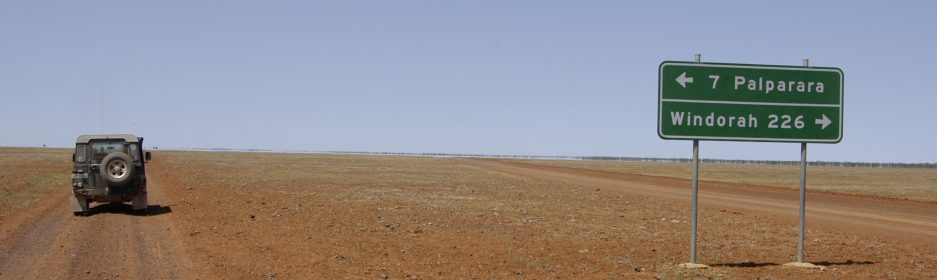
Well, my counter says 882 words and I’m not even lost yet. What does this mean? Here’s a clue to why you should stick around for the second episode:

DSC_0048 copy
THINK I’LL GET ONTO VKS-737 AND CHECK OUR COORDINATES – THIS DOESN’T LOOK RIGHT.

Hoo roo for now.

WRITING 101- DAY 3-COMMIT TO A WRITING PRACTICE

A commitment of fifteen minutes a day combined with today’s prompt, ‘three most important songs in my life’. All by free writing, just emptying the mind onto the page. I thought to myself, easier said than done.

Yet, just typing the words, three most important songs in my life, gave me an immediate idea, well, three really.

Three songs, first, ‘The Campbells are Coming’, played on the bagpipes of course, then, ‘Always Look on the Bright Side of Life’, performed by Eric Idle of Monty Python fame and finally, ‘Waltzing Matilda’, Australia’s unofficial National Anthem, penned by our bush balladeer, Banjo Paterson.

Why these three you might well enquire. Well, they’re not here in prioritised order, but rather, just as they popped into my head.

I chose ‘The Campbells Are Coming’ because it’s the Clan Hymn of the Campbell’s of Argyle in Scotland. A Clan, of which I’m a proud member. Why on the bagpipes? Silly question, it’s a Scottish traditional piece and when you hear the skirl of the pipes any Campbell gets goose bumps. I’ve just had a quick trawl through my photo album and have a look at this young Campbell( me, believe it or not) wearing the Black Watch Tartan as a young subaltern in the New South Wales Scottish Regiment, the 30th Infantry Battalion, circa 1958.

ME
COULD BE WORSE, I COULD BE IN COLOUR!

Next comes ‘Always Look on the Bright Side of Life’, best performed by Eric Idle. Ever since I heard it performed by him on the Monty Python show years ago, it’s become my personal mantra.

Many things happen during our life time. some great, some not so great and some downright rotten. Doesn’t matter if you follow a religion, are a fatalist/realist/pessimist or optimist, when the rotten bits bob up, what to think and what to do?

I always try and look on the bright side of life, works for me, not always easy, that’s for sure, but at risk of repeating myself, it works for me.

Now selfies are all the rage in photography these days so I did a quick trawl through mine and here is one that I can look at and see the bright side because now it doesn’t hurt a bit. I really like it because it gives many people the heebie jeebies when I show it, like right now:

ME copy
DOESN’T HURT A BIT—-NOW!

Wow, just looked at the time, 5 minutes over time already. Looking on the bright side, I’m not too worried because I’m enjoying myself.

My third favourite, ‘Waltzing Matilda’ by Banjo Paterson is a genuine Aussie classic and most of us Aussies know all of the words, off by heart. It’s easy to sing alone or in company and it’s a genuine Aussie bushies yarn out to music. Legends about it abound in the bush, and no more than in Winton, a little town in Queensland near the spot, as bush lore has it, where the legend of the song was born. As as well as some great pubs you will find the Waltzing Matilda Museum in Winton with great displays and information about the Banjo and the meaning of the song.

By the way, Winton and its surrounds are also world famous for their fossil dinosaur fields. Here’s a photo of one of Winton’s pubs, complete with a fibre glass dinosaur foot garbage can. It’s just down the road from the Waltzing Matilda Museum. Visit Winton sometime, you can’t miss either of them. 

WINTON _DSC0135 copy
THE TATTS IN WINTON- NOTE THE GREAT GARBAGE BIN TO THE LEFT.

So there we are, my three favourite  songs and ten minutes over time. I blame the dog for trying to eat my homework.

WRITING 101- DAY TWO- A ROOM WITH A VIEW

Suddenly, I’m wide awake to the sounds of crashing thunder and pelting rain. 5.30am according to the bedside clock. A quick look out through the blinds reveals total darkness, not even a glimmer from the street lights. I thought, oh no, not another electrical blackout for the lights and another day confined inside the house, no views, just pelting rain and a feeling of descending gloom for me.

Still half asleep, and without warning, I felt myself being transported, as if by magic, to the wonderful rounded red granite domes of Kata Tjuta National Park in the centre of Australia where it seldom rains, the sun always shines and the silence can be deafening.

Kata Tjuta, or The Olgas, as it used to be called by white Australians is the spiritual home of the Anangu people. I’ve been there many time before, experienced the mystery of its hidden valleys, changing light and cool shadows thrown by the rock walls and occasional trees.

I’m not in the least surprised by this morning’s sudden transport of my imagination to Kata Tjuta. Once there I’m not constrained by the pressures of daily existence. My mind can roam free of constraints. My imagination can run riot.

Aboriginal people call it ‘The Dreaming’.

Now, I’m nestled in my favourite space between two massive domes, looking down The Valley of the Winds. I can hear the rustle of the trees, the warble of the birds and feel the gentle rays of the Autumn sun warming my body. My body is totally relaxed and I feel as if I’m floating just above the ground. No tensions in mind or body, and I totally embrace the feeling.

Now, my thoughts gradually return, but not of accounts, obligations, responsibilities and desires. No, just soft pastel colours, pleasing sounds, gentle aromas and loving memories of people and places fill my thoughts. How lucky am I to be transported in my mind to Kata Tjuta. I give thanks to a long departed Pitjantjatjara friend who brought me to this Special Place and taught me all he could without breaking any traditional lore.

After what seems like an eternity, I’m suddenly conscious of the alarm clock. My blissful dreaming is no more.

Reality strikes, I am again in a room and yes, it does have a view, a mystical imaginary one into which I can escape should the need arise.

Facing reality is a necessity. I peer through the blinds, the rain is still tumbling down. This time I’m thankful as the rain is needed by the local farmers, for me, it settles the dust from nearby residential development, washes debris from our local river and refreshes everything.

Thank you Kata Tjuta for once again letting me realise that my city life is good. That I can relish the knowledge given me by my old Pitjantjatjara mate about the 36 giant domes and why he was unable to take me to other places within the domes as he himself could not go there.

Yes indeed, I’m looking forward to my next existential trip,knowing all the while that I’ll be back to my own room with a view.

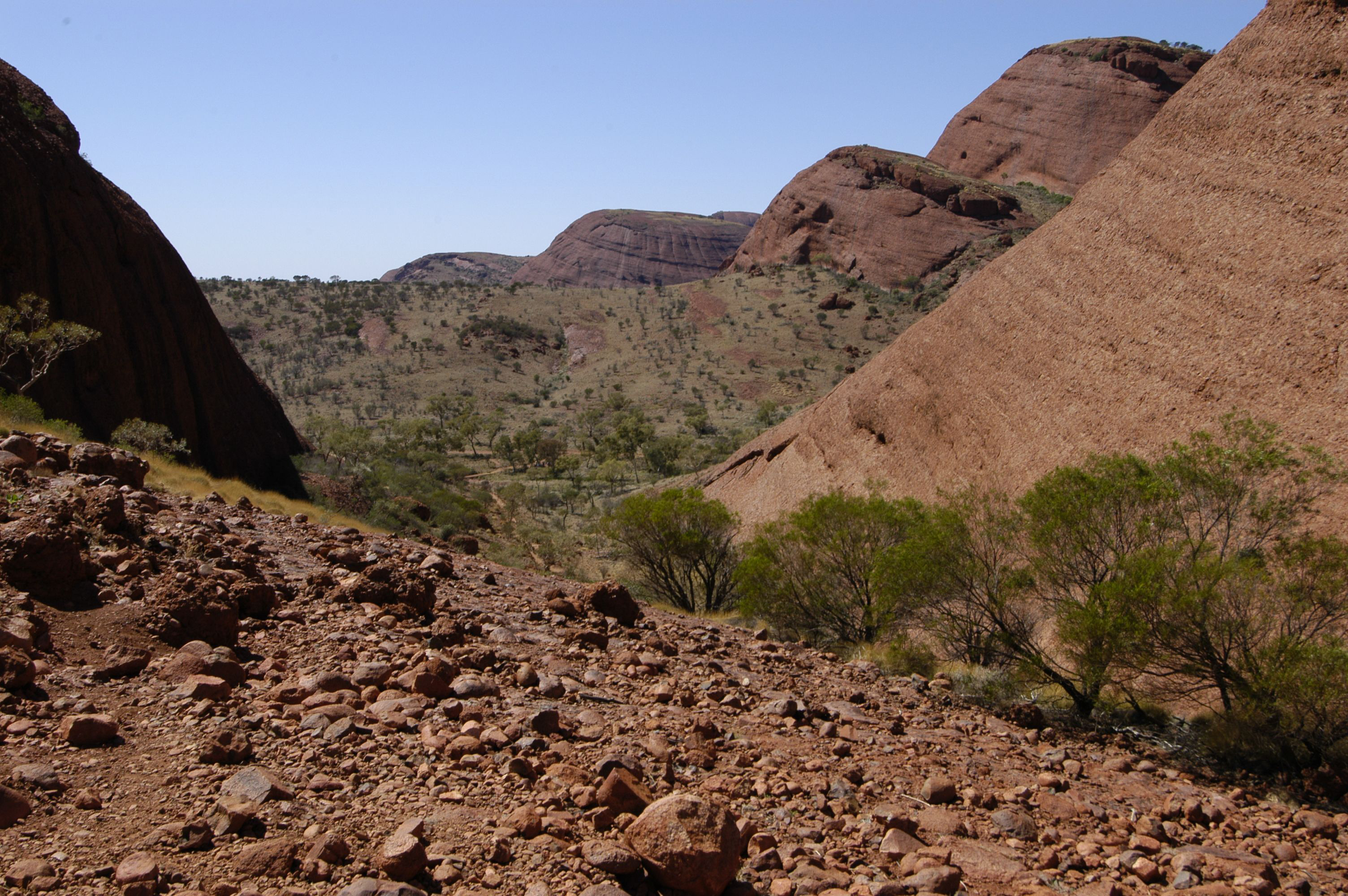
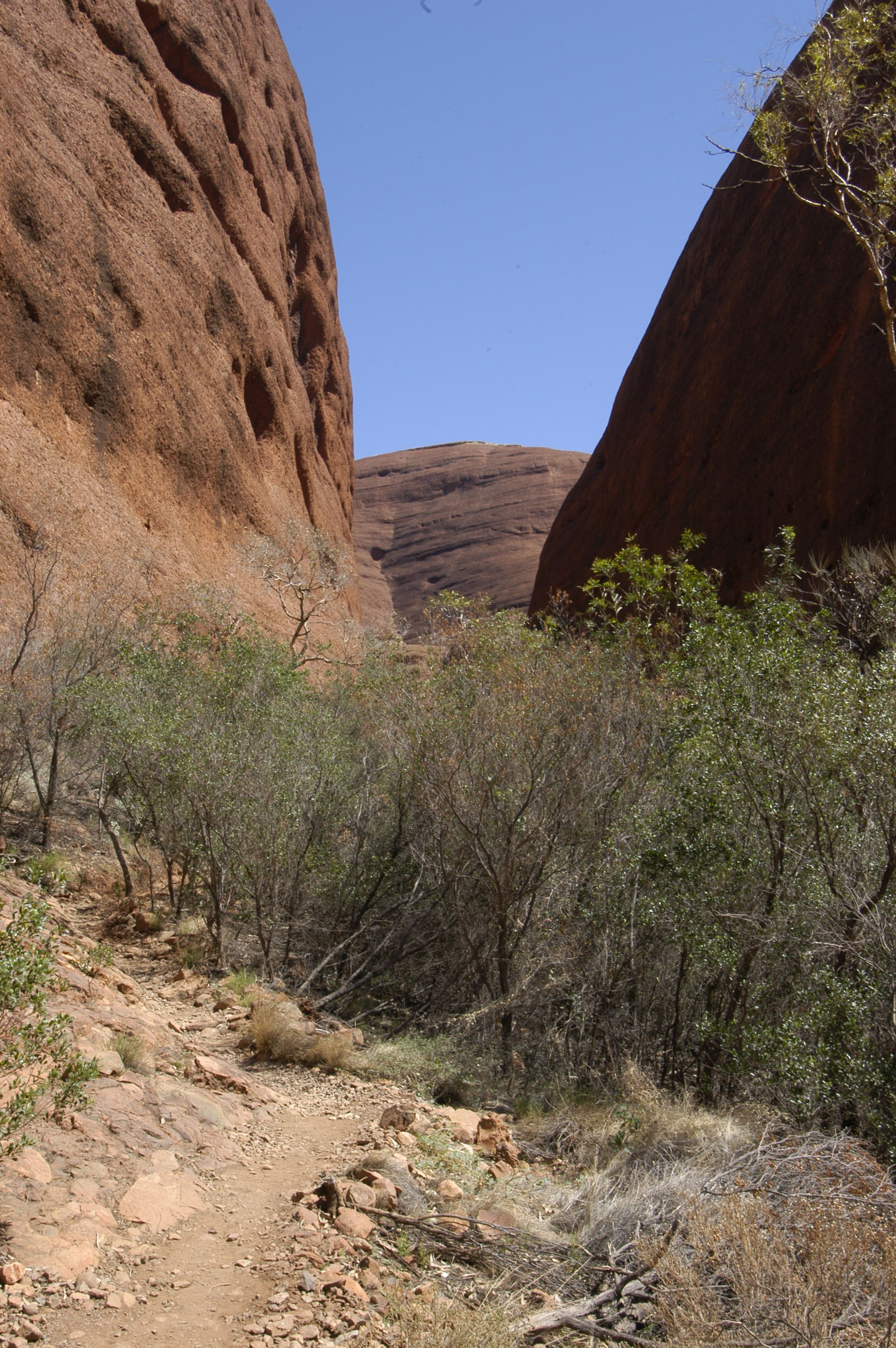
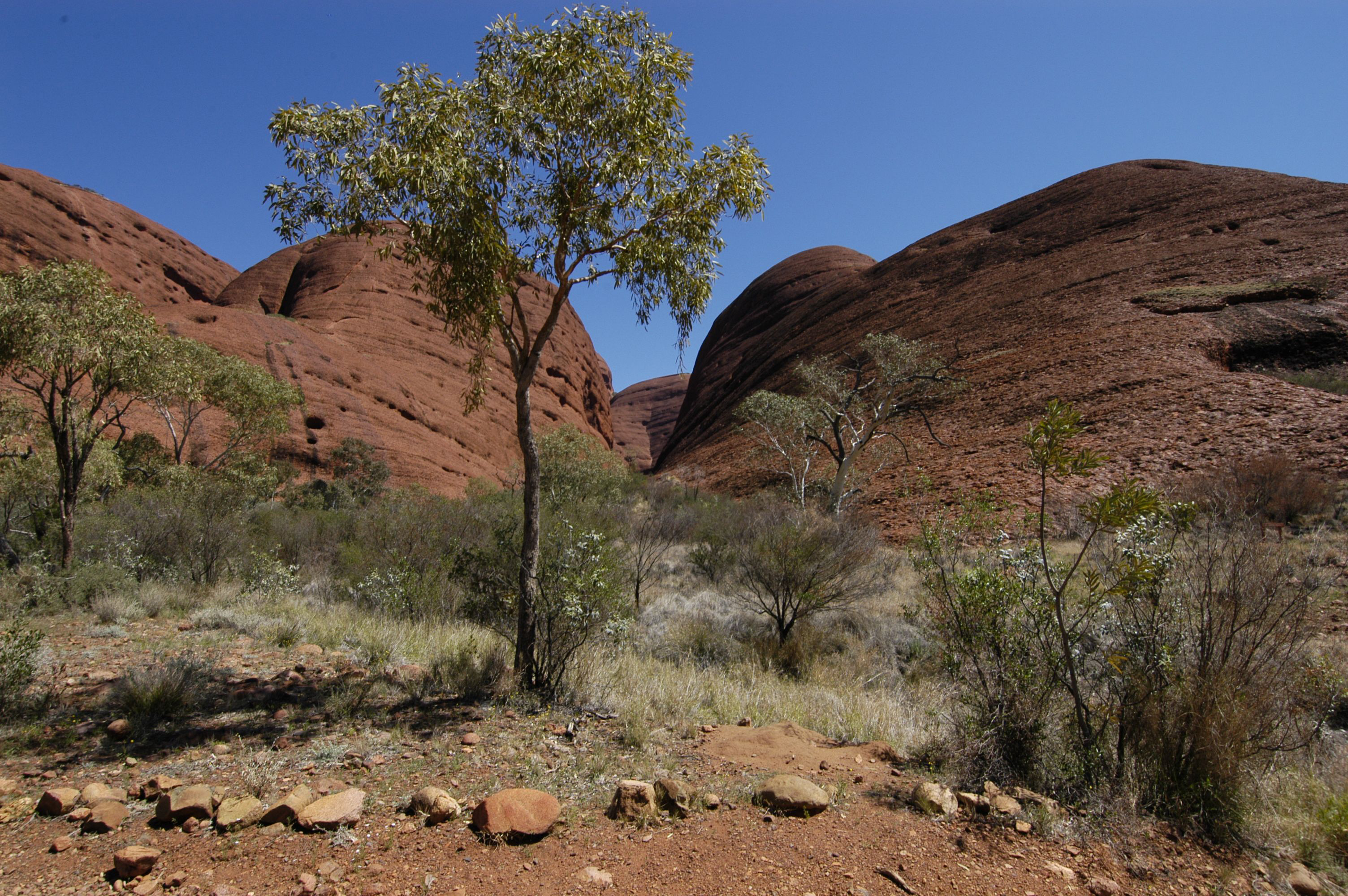
In the meantime, you can dream of being at magical Kata Tjuta, just allow yourself to float through these four images.

Looking into Kata Tjuta
LOOKING INTO KATA TJUTA – A MAGICAL PLACE FOR DREAMING.
Looking into Kata Tjuta
GETTING CLOSER TO THE DESCENT INTO THE VALLEY.
Looking into Kata Tjuta
THE WALLS SEEM TO CLOSE IN AS IF TO KEEP ALL EVIL OUT.
My favourite 'Dreaming' spot in Kata Thuta.
NEAR MY FAVOURITE ‘DREAMING’ PLACE IN KATA TJUTA.

WRITING 101 DAY 0NE UNLOCK THE MIND

Twenty minutes from now to unlock my mind and write whatever comes into my head. What a poser to begin with. The first thing that I though about was today’s 200 klm drive to try out a new lens for my camera. A few days ago I’d seen the trees but without the camera all I could do was look. Today was different, low light, misty rain, not ideal, but, by the time I got to the spot the rain had ceased, the cloud cover was still there and all was well. 20 images later I was on my way again, images safely on the memory card. Now I’m sitting here playing with words as they enter my mind at random, still marshalling my thoughts about the new lens and the images freshly off the card and onto the screen. Shall I post one or two images  Really can’t decide. Perhaps only one.

Then there is the question of my motorcycling. At my age should I still be out on the open road mixing it with the idiots in their tin tops whose only excuse after a near miss is,’sorry mate, I didn’t see you’.  I knows from experience that as you get older you don’t bounce off the bitumen as well as you did as a youngster, so that is now a constant in my mind.

Of course, if I give up riding, what will I do to fill in the day? There’s a limit to the amount of time a man can spend cutting the grass, feeding the wild birds, playing with the camera, washing the Landrovers, playing with the cats and most importantly of all, just doing nothing. Now that brings to mind the joke about the old bloke sitting in a deck chair under a tree in the yard with a cold beer in hand. His wife asked,’What are you doing?’ He replied, ‘Nothing’. She responded ,’ You were doing that yesterday’. He simply said to he,’ I know but I didn’t finish!’

Sitting dothing only works for me in the body department. The mind just keeps bouncing from one thing to another, just like at this moment in time. What to type next, who will be interested in my choice of off road tyres for the Landrovers, should I buy a Nikkor micro lense to compliment my existing 105mm?

What’s the point of getting another one when I hardly use the one I’ve already got. It’s great to have more lenses than the other blokes in the camera club. Trouble is lenses are getting more expensive and access to funds is getting tighter as the years roll on by.

How’s the watch going, Wow, been going fifteen minutes and the counter says 447 words. Five more minutes till the checkered flag drops and the event is over.

It’s been a lot of fun. If my touch typing was up to real speed, I could double the output. What would that achieve. It would only add to the boring content for people whom have chosen to follow me on this blog. Oh well in closing, here’s a photo from this mornings shots:

writing Trees with the 20mm_06Apr2015_0022 copy
AVENUSE OF TREES AS A TEST FOR MY NEW NIKKOR 20MM F1.8 LENS

Hoo roo for now, see you all tomorrow.;

THE AUSTRALIAN WAR MEMORIAL MUSEUM, CANBERRA, ACT.

Last Thursday, the 2nd April 2015 I went with fifteen otherFriends of the Goulburn Regional Art Gallery on a tour of the Australian War Memorial Museum in Canberra, our Nations Capital. The trip was organised by the Goulburn Regional Art Gallery as it is currently presenting an exhibition titled ‘A salute – Aussie Soldier from 1915 meets Young Turk in 2015’. The Goulburn exhibition recognises the sacrifices made by all sides in the Great War of 1914-1918.

The Australian War Memorial Museum in Canberra has devoted one of its many display areas to showcase part of their collection of World War 1 relics which dovetail nicely with the exhibition at our local gallery.

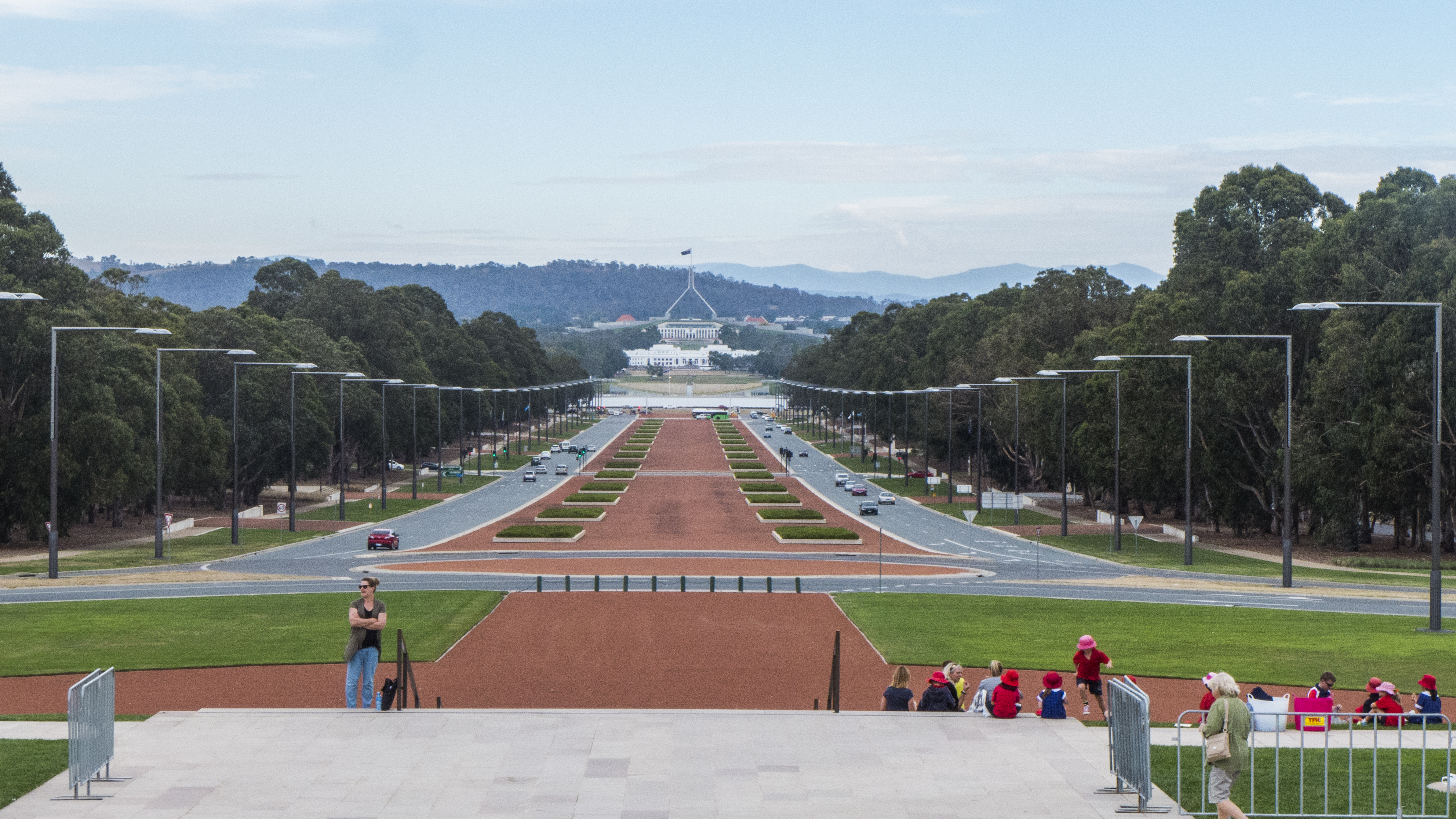
As you will see from the following image, taken from the front entrance to the Memorial, a broad boulevard leads the eye, firstly, to the old Australian Parliament House and then on towards the  home of the Australian Government’s new Parliament House, adorned by the wonderful flag pole  and our national flag.

GRAG War Memorial Trip_02Apr2015_0025 copy
THE BOULEVARD LEADING FROM THE AUSTRALIAN WAR MEMORIAL TO THE NEW AUSTRALIAN GOVERNMENT PARLIAMENT HOUSE.

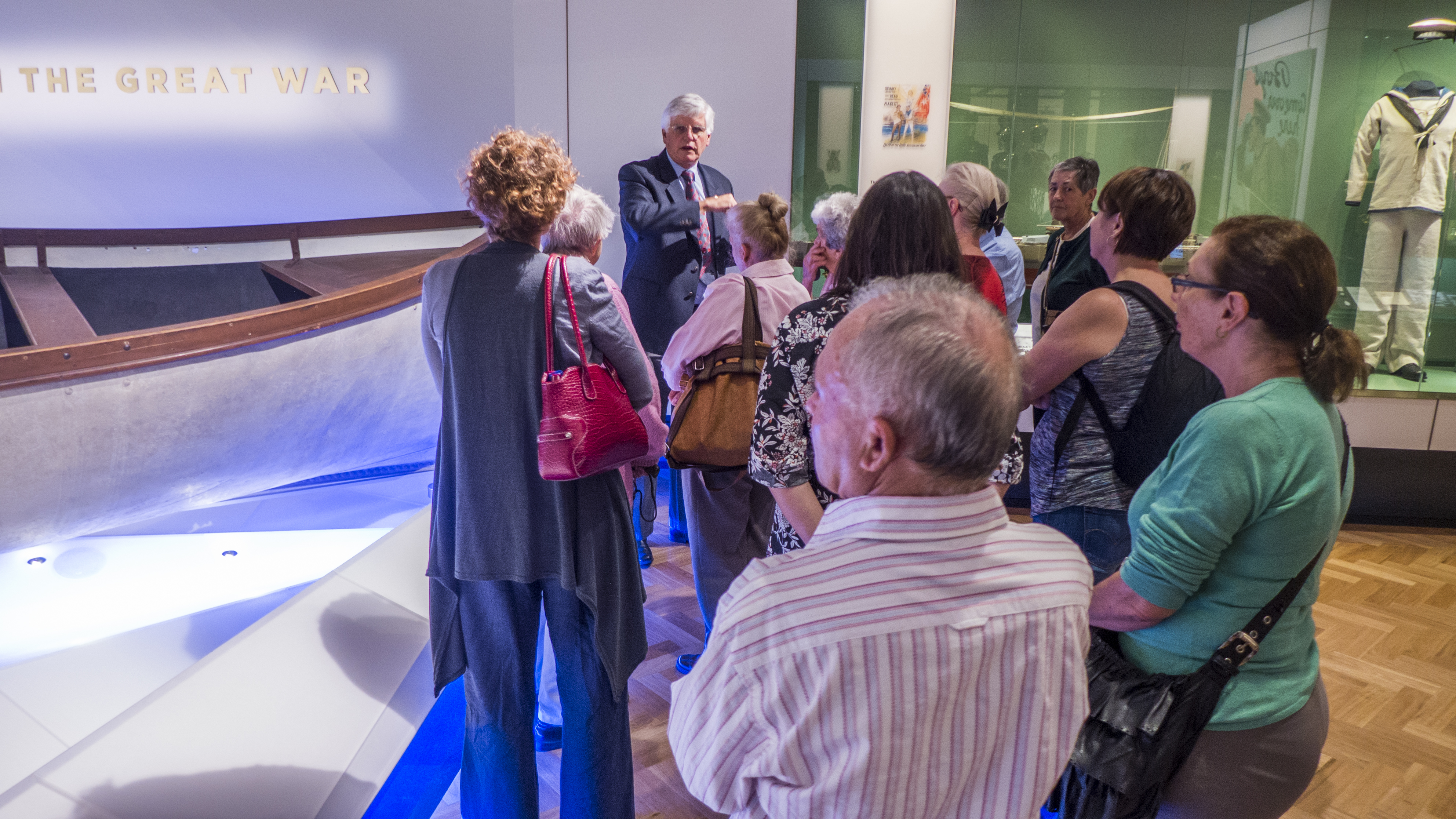
On arrival, we were met by our appointed guide and immediately commenced our tour. Our first stop was for orientation and took place next to a bullet riddled small boat saved from the battle front for future generations by a forward thinking official civilian war correspondent. Our guide is the distinguished looking man facing our small group.

GRAG War Memorial Trip_02Apr2015_0018 copy
ORIENTATION AND HOUSE RULES PRESENTED ADJACENT TO A BULLET RIDDLED SMALL BOAT.

Photography, minus flash, is welcome throughout the museum which is bursting at the seams with intriguing artefacts of the period.

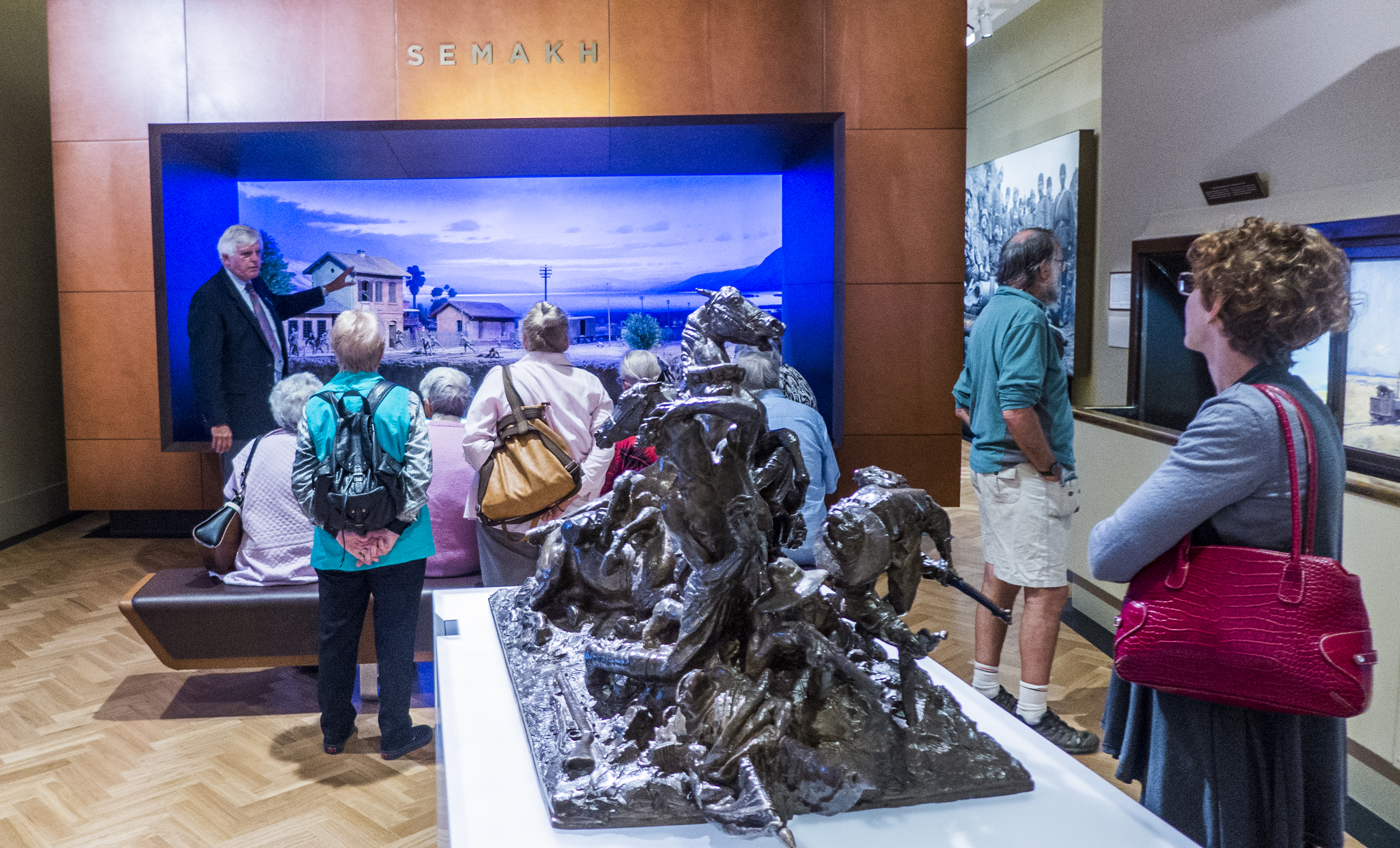
Many famous WW1 battles are explained by detailed dioramas and after a couple of hours pausing from time to time for detailed information from our guide, we stopped at a diorama depicting the final hours of the conflict on the 11th November, 1918.

GRAG War Memorial Trip_02Apr2015_0023 copy
A DIORAMA DEPICTING THE VILLAGE OF SEMAKH IN THE CLOSING HOURS OF WORLD WAR I ON THE 11th NOVEMBER 1918.

After a short lunch, our tour concluded with a brief explanation of the conservation process undertaken by the conservators and we then boarded our coach for the return home.

Our tour was an emotional and educational experience. The participants were unanimous in their desire to return to the Museum as there is so much of historical interest to be seen there.

The following image depicts the back view of the Museum. After all, everyone photographs the front.

GRAG War Memorial Trip_02Apr2015_0029 copy
REAR VIEW, AUSTRALIAN WAR MEMORIAL MUSEUM, CANBERRA – MOST IMAGES ARE TAKEN FOR THE FRONT, I JUST DARED TO BE DIFFERENT.

Hope you enjoyed the images and the read.

Hoo roo

LAST NIGHT AT THE CAMERA CLUB./

G’day, last night I went to the monthly meeting of a camera club to which I belong. The competition for the night was ‘The Colour Yellow’. At the club, you have the option of exhibiting prints on the night for the judge to evaluate, or submit digital entries some time in advance for the judge to evaluate at his leisure before delivering the awards of either Distinction or Credit on the night.

Members are entitled to enter three prints and or three digital entries. I chose to enter three prints.

I entered the yellow chickens which I may have shown previously in a Photo101 blog together with the following two:

YELLOW 4 OK TO PRINT 1656 copy
                                  FIRE FIGHTING BEAR – NOT BARE OF COURSE
PRINT + 30 YELLOW _DSC1504 copy
I’VE GOT A LOVERLY BUNCH OF BANANAS GROWING IN THIS EUCALYPTUS TREE.

In his opening remarks, the judge reminded us that judging photographic images is a pretty subjective exercise as we all have our own prejudices, intrenched opinions and our likes and dislikes. Fair comment too. I’m a qualified camera club judge and I always say exactly the same thing to entrants.

Well, the judging continued apace with the judge awarding Distinctions and Credits to images that took his fancy. On some occasions when he felt an award was not merited, he made a brief comment on where, in his opinion, the image wasn’t worthy of an award. That was excellent because we attend camera club competitions to learn.  Unfortunately for some entrants, the remarks were cursory.

When the judge came to my image of the firefighting bear, he dismissed it with the sole comment, ‘The author of this image should have used the rule of thirds and if the photographer knows nothing about the rule, then I suggest he or she learns it’. Fair comment I guess, but the rules of photography are made to be broken.

Then, the chickens and the egg. Lighting in the wrong place, creating too much brightness in the yellows and the background should be strongly cropped, too much brown and out of focus detail. Again, fair comment.

Then, the bananas in the eucalyptus tree. I nearly burst out laughing when the judge commented that the light on the bananas and the use of too much contrast was making them too yellow, and then awarded the image a Credit on the basis that although it had no photographic merit, it made him laugh.

As I said earlier, we go into camera club competitions to learn. Did I learn anything from this experience?

I certainly did, I now know his likes and dislikes. If I present before him again, I’ll crop my images like mad, obey the rule of thirds to the letter, hold back on the brightness, restrict contrast and try to make him laugh.

Why am I writing this blog. Not to criticise the judge, that’s for sure.  He stuck to his principles and we can have no argument against that.

I just want to get the message across that none of us publish an image on our blog, exhibit in competitions or give our photographs away as presents unless we are happy with our work and like what we have produced.

In the end, that’s all that matters.

Hoo roo for now